.png)
 4 hours ago
4
4 hours ago
4
If you have part of your portfolio in an S&P 500 index fund, you’re probably patting yourself on the back for the 12%-plus performance you’ve already notched this year. But you could have done even better.
A less flashy corner of the index-fund world treats Nvidia and a random mid-cap industrial stock as equals. It is beating the market by a wide margin. The Invesco S&P 500 Equal Weight ETF (RSP) is up 15.95% year to date through Aug. 26, compared with 12.37% for the iShares Core S&P 500 ETF (IVV)—a nearly 3.58 percentage-point gap that has put equal weighting back in the spotlight.
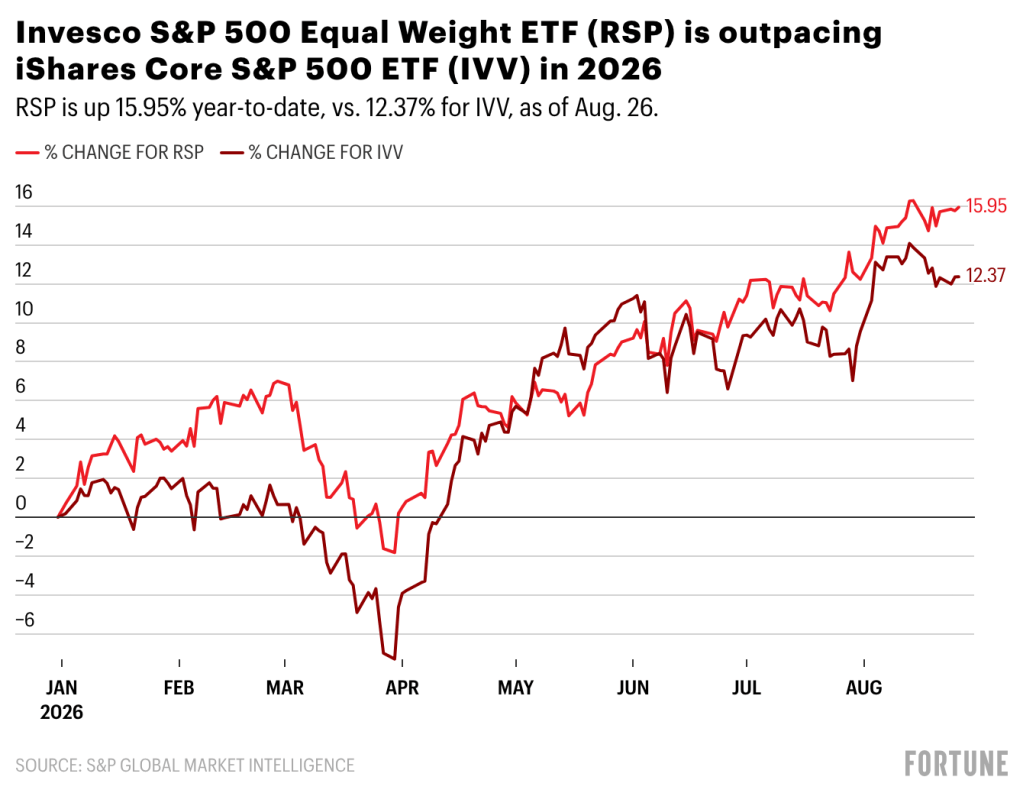
That outperformance just reached a milestone of its own: RSP crossed $100 billion in assets under management for the first time on Aug. 19, capping a run that has seen the fund pull in more than $12 billion in net inflows in 2026 alone.
Why equal weight funds are beating the market
The mechanics explain the divergence. A market-cap-weighted fund like IVV gives its largest constituents, such as Nvidia, Microsoft, Apple, and Amazon, outsized influence because they represent an outsized share of the index. RSP instead assigns each of the 500 companies roughly the same weight at each quarterly rebalance, muting the influence of any single giant.
That structural difference matters in 2026, Brendan McCann, senior associate manager research analyst at Morningstar, told Fortune.
He pointed to underperformance among several of the market’s largest names as the key swing factor: “Several of the big names in the market, like Microsoft, Nvidia, and Apple, have underperformed the broader technology market. Since RSP underweights those companies, its performance is more insulated when those stocks underperform.”
The flip side has reinforced the trend. “Several smaller S&P 500 stocks have performed exceptionally in 2026, and equal weighting gives those stocks more weight,” McCann said. RSP is therefore not just avoiding tech’s laggards—it is capturing upside from smaller names that a cap-weighted fund would barely register.
How crowded is the trade?
This milestone naturally raises the question of whether the equal-weight trade has become too popular for its own good. McCann isn’t worried yet. “I think at $100 billion the ETF still has plenty of runway,” he said.
But he flagged a real constraint tied to fund size: liquidity in RSP’s smallest holdings. As the size of the ETF climbs, it gets harder to trade the smallest stocks in the portfolio, McCann said.
“There’s no perfect number for how large the assets could grow, but I would say if assets were to quadruple, it could be more challenging to rebalance the portfolio.” That would put the potential stress point near $400 billion.
What the gap reveals about the broader market
McCann sees that gap as a live snapshot of just how much the S&P 500 now depends on a handful of giant stocks.
The primary driver, especially with the concentration in the market today, is the performance of the largest stocks relative to the broader market, he explained. Because so many of those largest stocks sit in one sector, technology’s fortunes disproportionately steer the cap-weighted index’s returns.
The numbers illustrate just how lopsided that concentration has become. As of Aug. 25, the S&P 500 Equal Weight Index held roughly 17% in technology, versus a 38% technology weighting in the standard S&P 500 Index—a gap of about 21 percentage points, according to McCann. The cap-weighted benchmark tracked by most index funds and 401(k) target-date funds is, in effect, a leveraged bet on one sector.
The implication cuts both ways. “Should the technology sector take a hit, RSP should hold up better than the broader market,” he said, which is a defensive case for equal weighting.
But it also means RSP’s fortunes will keep hinging on tech’s next move: a rebound in Nvidia, Microsoft, or Apple could just as easily narrow the performance gap that has fueled this year’s inflows.
This story was originally featured on Fortune.com








 English (US) ·