.png)
 1 hour ago
1
Traders are looking on the bright side today: Talks between Saudi Arabia and Iran are ongoing, and the credit ratings agency Moody’s left France’s credit rating unchanged from before the riots. The yield on France’s 10-year bonds eased back below the headline-inducing 5% level to 4.94%; similarly, the U.S. 10-year was at 4.99%.
U.S. futures were up this morning prior to the bell in New York after stocks rose in Europe in early trading.
Asia was flat to down today as the price of oil remained painfully high—above $114 per barrel.
Incoming: Alphabet and Microsoft report Q3 earnings on Wednesday and Amazon reports on Thursday. The Fed decides on the base interest rate on Wednesday—futures markets are it will be held at 3.75%.
- S&P 500 futures were up 0.32% this morning. The index fell 0.52% on Friday.
- In Europe, the Stoxx 600 rose 0.39% in early trading, and the U.K.’s FTSE 100 rose by 0.5% before lunch.
- Asia: South Korea’s KOSPI was down 1.46%. Japan’s Nikkei 225 was down 0.8%. India’s Nifty 50 was up 0.52%. China’s CSI 300 was flat.
- Brent crude was $114 per barrel.
- Bitcoin declined to $80,440.
Bad news in tech stocks disguises good news everywhere else
Last Thursday was a very good day for U.S. stocks, as 337 of the S&P 500 stocks rose on the day. Although you might not have noticed that, given the S&P 500 lost 1.21% and the tech-heavy Nasdaq fell 2.9%. In reality, those declines reflected the overweight status of tech stocks in the index: The equal-weight version of the S&P actually went up. On 2,887 of 7,827 trading days since 1996, 300 or more of the S&P stocks have risen. But last Thursday’s aggregate performance was the second-worst of all those 300-plus days, according to Deutsche Bank’s Jim Reid.
“The only worse occasion was 27 January 2025, when the index fell -1.46% despite 351 stocks rising. That was the day DeepSeek challenged assumptions around the need for costly AI capex. NVIDIA fell -17%,” Reid told clients.
AI companies are worried that the world will run out of money
While stock traders spent much of last week worrying that AI was a bubble, AI executives were worrying that the opposite is true: Their growth is being constrained by a lack of money. Meta’s stock sold off after its earnings call because the company reported its AI capex was so large it now had negative free cash flow, and it raised its guidance on how much capex it was going to spend through the rest of the year.
Meta’s 10-Q states it may not be able to raise more money: “Such financings may not be available on favorable terms or at all.” With multiple companies like Oracle, OpenAI, Alphabet and SpaceX trying to raise hundreds of billions through equity or debt, competition for available capital is fierce.
“Investors interpreted the move as a sign that even hyperscalers may be rushing to secure financing before competitors absorb the available capital,” according to Ed Yardeni and Elias Griepentrog of Yardeni Research. “Does enough capital even exist to finance everyone’s ambitious AI spending plans?”
Broadcom CEO Hock Tan, BlackRock CEO Larry Fink, and Nvidia CEO Jensen Huang have all warned recently that there might be enough money to go round, Yardeni said.
Is it a bubble? It sure looks like one
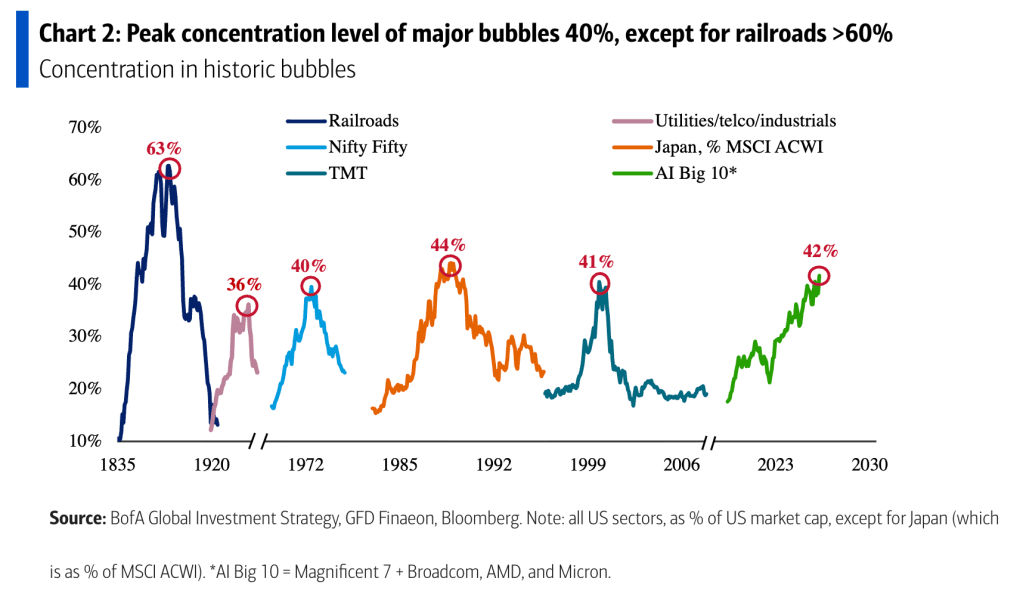
This chart from Michael Hartnett and his team at Bank of America shows the concentration of bubble stocks inside the overall indexes of their day. With the exception of the railroad bubble of the 1800s, once the market cap of the bubble stocks reaches 40% of the broader index, a crash soon follows, history shows.
The aggressive, levered-up retail traders who love it when stocks go down
For long-term investors—people saving into a pension or 401(k)—exchange-traded funds are usually the best idea. Most stock-pickers fail to beat the market, so you might as well own the whole market, which generally puts on 6-10% per year. “Don’t look for the needle in the haystack. Just buy the haystack!” as the late Vanguard founder Jack Bogle used to say.
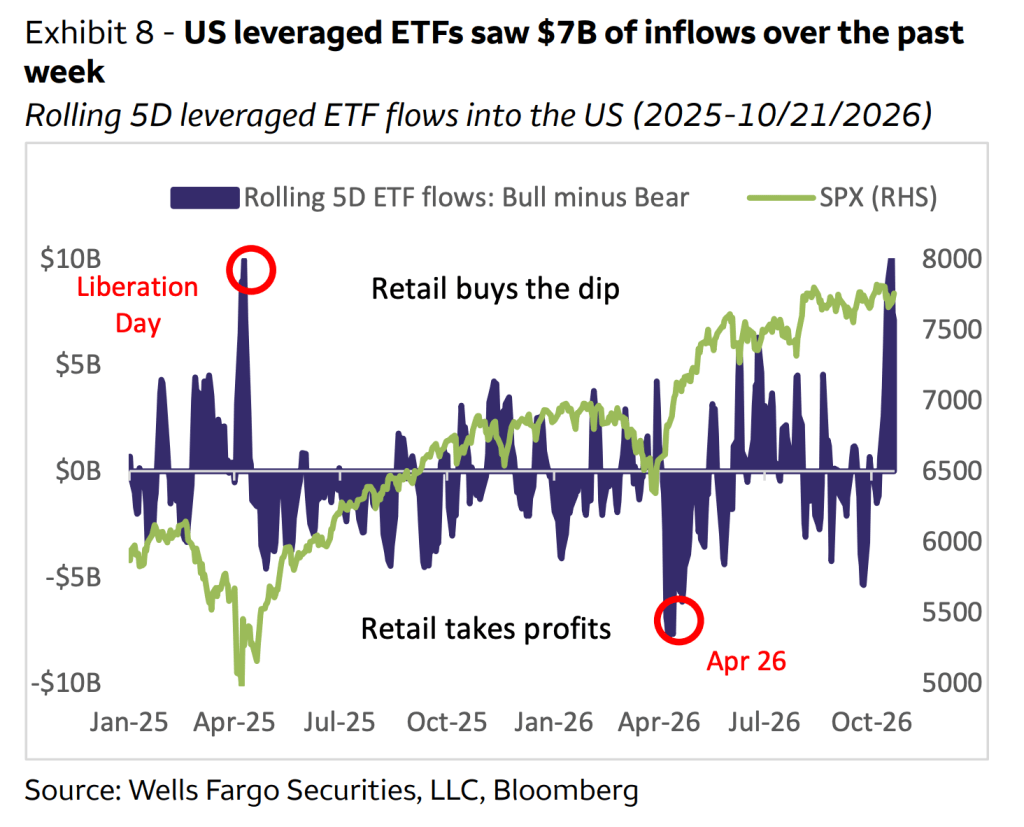
But some aggressive retail investors want the diversification of an ETF with the gains of a day trader. They use leveraged ETFs, which use borrowed money to magnify your gains and losses. Wells Fargo tracked 546 leveraged ETFs in the U.S., with $160 billion in assets between them, and found that levered-up retail buyers love bad news and consistently buy the dip. Last week, they waded into the carnage, which was as bad as last year’s “Liberation Day” selloff as far as they were concerned.
Read the full digital edition of today’s Fortune 500 Digest here.
This story was originally featured on Fortune.com








 English (US) ·