.png)
 55 minutes ago
1
55 minutes ago
1

KUALA LUMPUR, Sept 16 — Malaysia is estimated to be losing around US$775 million (RM3.2 billion) in tax revenue annually to illicit tobacco, with illegal products accounting for more than half of the market, according to a new regional study.
In a media release, The Center for Market Education (CME) estimated Malaysia’s illicit tobacco market share at 55 per cent, making it one of the most severe cases among 14 Asia-Pacific economies examined in its latest policy paper.
Pakistan recorded a similarly high illicit share of 54 per cent, while Australia was estimated at 60 per cent.
According to CME, the estimated revenue lost to illicit tobacco in both Malaysia and Pakistan now exceeds the amount governments collect from tobacco taxation, suggesting significant erosion of the legal tax base.
The findings form part of CME’s Illicit Tobacco Trade in Asia-Pacific: Taxation, Market Incentives, and Macroeconomic Costs, released today.
Across countries for which comparable estimates could be calculated, the study estimated governments collect around US$30.98 billion in tobacco taxes while losing another US$14.85 billion to illicit trade.
That translates to nearly US$48 in estimated revenue lost for every US$100 collected in tobacco taxes.
The study estimated the losses were equivalent to around 1.63 per cent of total tax revenue, 4.27 per cent of current health expenditure and 7.71 per cent of government education expenditure across the sample.
Australia recorded the largest estimated revenue loss at US$9.60 billion, followed by Indonesia at US$1.65 billion.
Pakistan was estimated to lose around US$999 million, while Malaysia’s loss stood at US$775 million and Thailand’s at US$567 million.
Indonesia, despite having an estimated illicit-market share of just 10.77 per cent, recorded the second-highest monetary loss — something CME attributed to the sheer size of its tobacco market.
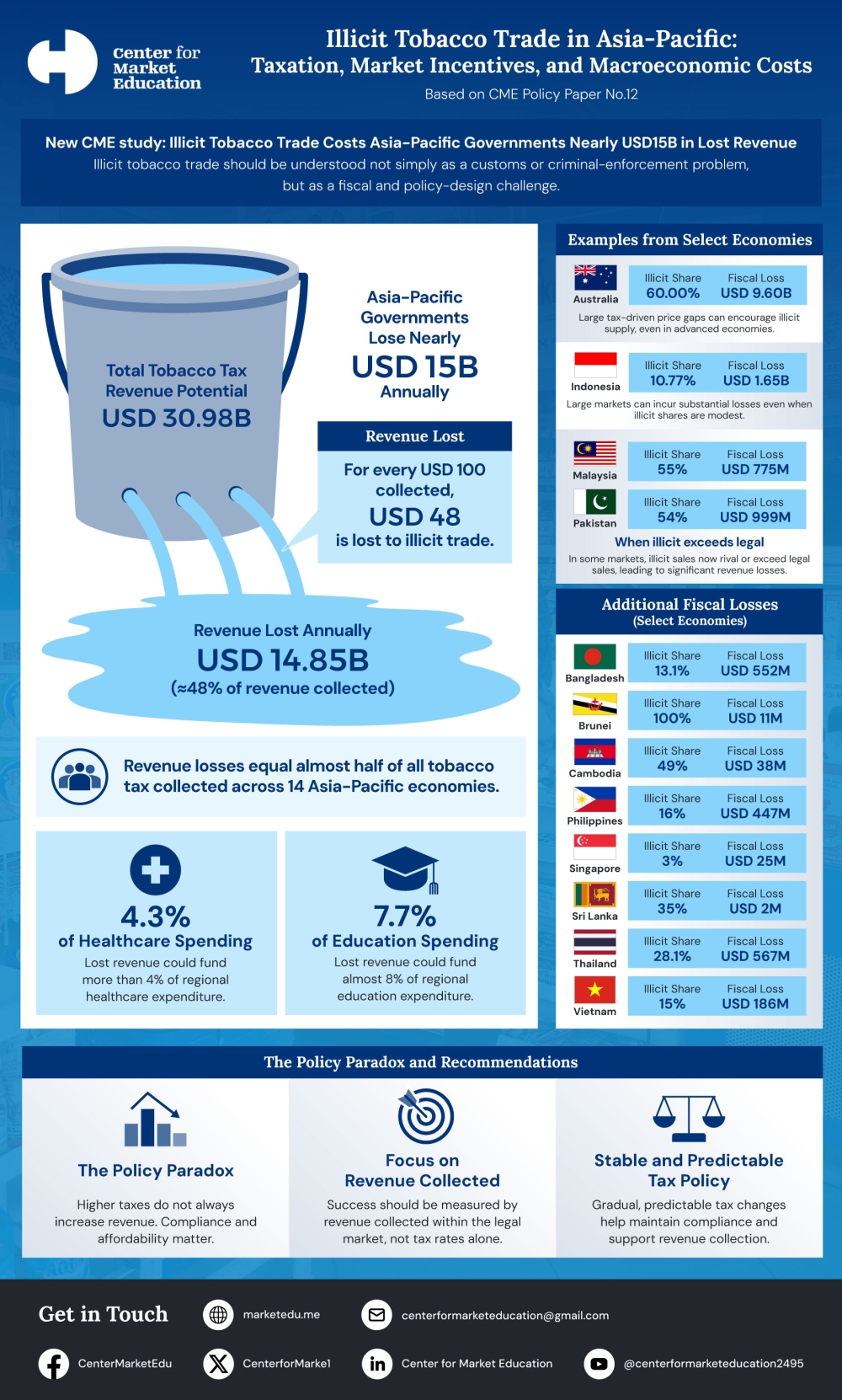
The paper argues that illicit tobacco should be viewed not only as a customs or law-enforcement issue, but also as a fiscal and tax-policy challenge.
It cautioned against assuming that higher tobacco excise rates would automatically translate into greater government revenue, arguing that taxation is effective only when enough consumption remains within the legal and taxable market.
CME chief executive officer and study author Dr Carmelo Ferlito said policymakers should look beyond statutory tax rates to how much revenue governments actually manage to collect.
“The relevant question is not simply how heavily tobacco is taxed, but how much of that tax can actually be collected,” he said in a statement.
“When taxation pushes an increasing share of consumers outside the legal market, governments risk undermining their own fiscal objectives.”
The paper recommends gradual and predictable excise changes alongside assessments of a country’s enforcement capacity.
For markets already experiencing high illicit penetration, CME suggested temporary tax freezes or more moderate adjustments while efforts are made to stabilise the legal market.
It also called for closer cooperation between tax authorities, customs, police, border agencies and regulators, stronger enforcement against illegal production and distribution networks and independently verifiable monitoring of illicit tobacco penetration.
Regional cooperation should also be strengthened to tackle cross-border illicit supply chains, it said.
Ferlito said tax increases should be evidence-based and compatible with enforcement capacity, arguing that policymakers should consider actual revenue collected, legal-market volumes and illicit-market penetration when assessing tobacco policy.








 English (US) ·