.png)
 1 hour ago
1
1 hour ago
1
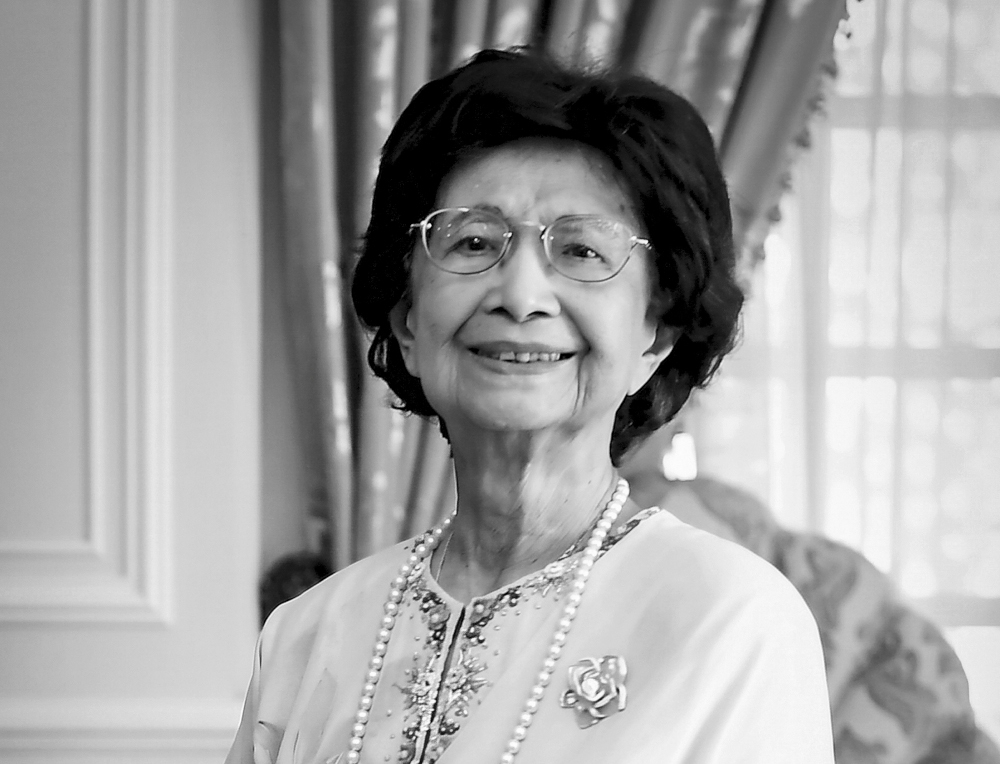
KUALA LUMPUR, Sept 28 — Malaysia mourns the loss of Tun Dr Siti Hasmah Mohd Ali, a pioneering doctor and public health advocate, who died at the National Heart Institute (IJN) today at the age of 100.
Beyond her role as the dedicated life partner of Tun Dr Mahathir Mohamad, Tun Dr Siti Hasmah forged a distinguished legacy in medicine and public service, championing maternal and child health, immunisation, rural women’s development, drug abuse prevention and adult literacy.
Her decades of public service and advocacy eventually took her beyond Malaysia, where she championed many of the same causes internationally.
Despite a career spanning decades in medicine, becoming a doctor was not Tun Dr Siti Hasmah’s original ambition. She had initially wanted to become a journalist before circumstances led her to medicine, a profession through which she would serve the country for decades.
Born in Kampung Jawa, Klang, Selangor, on July 12, 1926, Tun Dr Siti Hasmah was the sixth of 10 children of Mohd Ali Taib and Siti Khadijah Ahmad.
She received her early education at Sekolah Melayu Kampung Baru, Methodist Girls School, St Mary’s School and later Pudu English Girls School. In 1947, she enrolled at the King Edward VII College of Medicine in Singapore and was the only Malay woman studying medicine at the institution that year.
After enduring the demands of medical training, she graduated in June 1955, becoming one of the earliest Malay women to enter the medical profession at a time when it was still largely dominated by men.
Tun Dr Siti Hasmah began her career as a house officer at Kuala Lumpur Hospital in 1955 before moving to Kedah the following year, where she was appointed a lady medical officer at Alor Setar Hospital.
It was in Kedah, her husband’s home state, that she witnessed first-hand the healthcare challenges faced by rural communities - an experience that would shape much of her subsequent work in public health.
In 1962, she was appointed acting medical superintendent for northern Kedah. Three years later, she became the first woman appointed as a medical officer in the Maternal and Child Health Department and also served as principal of the Rural Health Training School in Jitra.
In her 2016 autobiography, My Name is Hasmah, the former first lady recalled how her years in Kedah opened her eyes to the lack of health awareness among rural women and children.
Among the challenges were inadequate care during pregnancy and childbirth, as well as infant care complicated by poverty, traditional practices, taboos and limited health knowledge.
In a 2021 interview, she recalled her concern over potentially fatal childhood diseases at the time, including tuberculosis, polio, whooping cough, diphtheria and tetanus, which prompted her and her team to travel to villages to provide treatment, immunisation and health education directly to rural communities.
She also worked to ensure traditional village midwives received proper training to provide safer and more effective care for mothers and babies.
In a 1997 speech, Tun Dr Siti Hasmah recalled how her team brought government health programmes directly to communities, covering immunisation, nutrition, infectious disease prevention, malaria eradication and care for high-risk pregnancies.
“By the time I left Kedah, it was with deep satisfaction that the people had chosen to accept the government’s health programmes and had benefitted from them,” she said at the opening of R.I. District 3300 in Kuala Lumpur in 1997.
The efforts were also associated with a significant decline in infant mortality, an achievement that later allowed her to share Malaysia’s public health experience in Washington, United States.
Tun Dr Siti Hasmah retired from government service in 1979 before joining Universiti Malaya’s Faculty of Dentistry as a part-time lecturer in social medicine until 1981.
Her contributions earned her numerous honours, including Kedah’s Excellent Service Medal in 1964 for her role in tackling a cholera outbreak, the Asia HRD Lifetime Achievement Award in 2019, and the National Anti-Drug Icon Special Award in 2020.
Beyond medicine, Tun Dr Siti Hasmah was active in numerous organisations and maintained close ties with Malaysian badminton as a patron of the Badminton Association of Malaysia (BAM), and was regarded as a maternal figure by national players.
Her advocacy also took her to the international stage. She represented Malaysia at an international conference on drug abuse in Vienna in 1987 and served as patron of the Pan Pacific and Southeast Asia Women’s Association Malaysia.
Her commitment to advancing rural women also saw her attend the First Ladies Summit for the Economic Advancement of Rural Women in Geneva in 1992, where she was selected as one of six Core-Group Initiators of First Ladies representing the Asia-Pacific region.
In 2001, she led a 15-member group of women comprising doctors, educators, writers and academics on a humanitarian visit to Iraq to witness the conditions faced by its people, particularly children affected by United Nations economic sanctions.
From the villages of Kedah to the international stage, Tun Dr Siti Hasmah’s journey reflected a lifelong commitment to public health and the welfare of women and children.
Beyond the titles and accolades, words attributed to her in the book Suri Hati Mahathir, The Other Half, perhaps best capture the legacy she hoped to leave:
“I have nothing to give or leave to the people except my love and advice. Take them and put them into practice.” — Bernama






 English (US) ·